
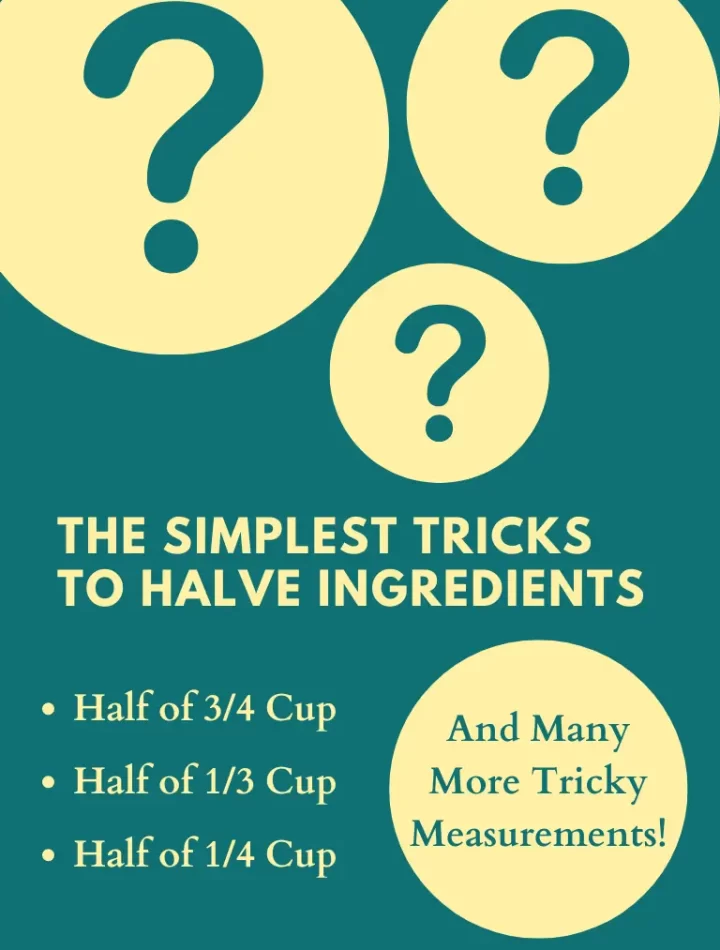
If you want to make halves ingredients and you’re not sure how to half 1/3 cup (or other tricky measurements), we can help!
We will show you how to find out what half of 1/3 cup is (and other tricky measurements) so you can easily change the amounts of ingredients in your favorite recipes!
There’s a good chance that at some point while cooking or baking, you’ve had to make half of a recipe.
Maybe you don’t want to make a whole pan of Soft Vanilla Cookies, so you decide to make a smaller batch. Or maybe it’s just you and your partner for Thanksgiving this year, so you only need to make a few Custard Slices.
Whatever the reason, it’s common for home cooks to need to make a recipe smaller.
Even if it’s been a while since you worked with fractions and decimals, adjusting the amounts doesn’t have to be hard.
Let’s Measure Together
Measurements in Half
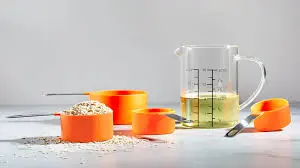
When you’re using the US spoon and cup measurement system, it’s usually quite easy to adjust the quantities of ingredients to modify a recipe.
These spoons and cups usually double in size as they get bigger, so a standard measuring cup set often includes 1/4 cup, 1/2 cup, 1 cup, and sometimes 1/3 cup.
Two 1/4 cups = 1/2 cup
Four 1/4 cups = 1 cup
Two 1/2 cups = 1 cup
Three 1/3 cups = 1 cup
A standard measuring spoon set usually includes 1/4 teaspoon, 1/2 teaspoon, 1 teaspoon, and 1 Tablespoon.
Two 1/4 teaspoons = 1/2 teaspoon
Four 1/4 teaspoons = 1 teaspoon
Two 1/2 teaspoons = 1 teaspoon
3 teaspoons = 1 Tablespoon
If you need to change between spoons and cups, you can use this easy guide:
1 cup = 16 Tablespoons
1/2 cup = 8 Tablespoons
1/4 cup = 4 Tablespoons
You can also check out our full conversion chart for common measurements and how to make them smaller.
How Much is Half of 1/3 Cup?
Using the information above, it’s easy to cut even numbers in half, like a full cup or half a cup.
But what do you do when the numbers aren’t as easy to divide?
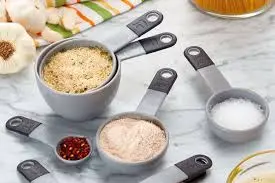
One tricky measurement to half is 1/3 cup.
Since 1/3 cup is equal to 5 tablespoons plus 1 teaspoon (or 16 teaspoons total), we can halve that to 2 tablespoons plus 2 teaspoons (which is the same as 8 teaspoons total).
So, half of 1/3 cup is 2 tablespoons plus 2 teaspoons.
How Much is Half of 1/4 Cup?
If your measuring cups don’t go smaller than 1/4 cup, how do you cut that amount in half?
This one’s easier because of the round numbers. Since 1/4 cup equals 4 tablespoons, we can easily cut that in half to 2 tablespoons.
So, half of 1/4 cup is 2 tablespoons.
How Much is Half of 3/4 Cup?
But what is half of 3/4 cup?
Since 1/4 cup equals 4 tablespoons, we know that 3/4 cup equals 12 tablespoons.
So, half of 3/4 cup is 6 tablespoons.
This is the same as 1/4 cup plus 2 tablespoons.
Reference Chart
The conversion chart below shows common measurements, along with 1/2 the amount and 1/3 of the amount. It’s great for when you need to make a recipe smaller!
| Amount | 1/2 of Amount | 1/3 of Amount |
|---|---|---|
| 1 cup | 1/2 cup | 1/3 cup |
| 3/4 cup | 1/4 cup + 2 Tablespoons | 1/4 cup |
| 1/2 cup | 1/4 cup + 2 teaspoons | 1 Tablespoon + 1 1/4 teaspoons |
| 1/3 cup | 2 Tablespoons + 2 teaspoons | 1 Tablespoon + 1 1/4 teaspoons |
| 2/3 cup | 1/3 cup + 3 Tablespoons + 1 1/2 teaspoons | 1/4 cup + 2 Tablespoons |
| 1/4 cup | 1/8 cup | 1 Tablespoon + 1 teaspoon |
| 1/8 cup | 1 Tablespoon | 2 teaspoons |
| 1 Tablespoon | 1 1/2 teaspoons | 1 teaspoon |
| 1 teaspoon | 1/2 teaspoon | heaping 1/4 teaspoon |
| 1/2 teaspoon | 1/4 teaspoon | N/A |
| 1/4 teaspoon | 1/8 teaspoon | a dash or pinch |
Guide to Halving Wet Ingredients
When cooking or baking, it’s important to use the right tools for measuring liquids. For wet ingredients like water, oil, or vinegar, use a liquid measuring cup instead of a dry-ingredient measuring cup. This is because liquid measuring cups are designed to handle liquids and often have measurement markings on the side.
For small amounts of liquid, such as extracts or flavors, you can use measuring spoons.
However, for thick or sticky wet ingredients like Greek yogurt or nut butters, it’s often easier to use a dry-ingredient measuring cup. The same chart for halving amounts of ingredients applies to wet ingredients as it does to dry ones.

How to Halve Ingredients Not Measured with Cups/Spoons
If you’ve ever needed to halve a recipe that calls for 1 egg, you know it can be tricky!
Here are a few tips for halving ingredients that aren’t measured in cups and spoons.
How to Halve an Egg
To halve a single egg, crack it into a small bowl or a coffee cup. Use a fork or whisk to beat the egg until the yolk and white are well-mixed.
Then, measure 2 tablespoons of the egg mixture to use as half of the egg in your recipe.
How to Halve a Stick of Butter
Cutting a stick of butter in half is actually easier than you might think! Most butter sticks come with packaging that has tablespoon markings.
These markings make it easy to cut the stick in half. Since there are 8 tablespoons in a stick of butter, you’ll need to cut at the 4-tablespoon mark.
Using the Metric System in Baking and Cooking
Many other countries use a measurement system called the metric system.
You might remember it from science classes, as it includes measurements in grams and liters (and their smaller and larger units, like milligrams, kilograms, milliliters, etc.).
If you’re using a recipe written with the metric system, you can halve the ingredients by simply halving the amount.
For example, 500 grams would be halved to 250 grams. Similarly, 250 milliliters would be cut down to 125 milliliters.
How to Halve Ingredients with a Kitchen Scale
If you’re measuring by weight, a kitchen scale is very helpful!
Place your measuring cup or bowl on the scale, zero it out, then add your ingredient to the cup or bowl.
Watch the numbers on the scale as they go up to your target amount, adding more or less as needed.
How to Halve Metric Ingredients without a Scale
If you don’t have a kitchen scale, you can convert the metric measurements to the US cup and spoon system, then use our chart to adjust ingredients by 1/2 as needed.
This method is a bit more work but works if you don’t have a kitchen scale.
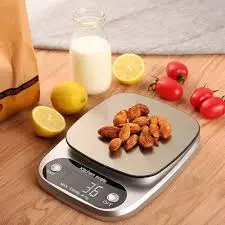
Is a Kitchen Scale Worth It?
I’ll be honest, I managed for YEARS without a kitchen scale. But I’ve had one for a couple of years now, and I do find it useful.
The good news is that kitchen scales are relatively cheap. You can get one for less than $20, so even if you use it occasionally, it’s a good buy.
If you use a lot of metric recipes, I think it’s definitely worth having.
But if you mainly use recipes with cups and spoons, it’s not essential, but it can be helpful.
I mostly use mine when making sourdough (which I measure in metric units) or when weighing ingredients.
Have you ever seen a recipe that calls for 2 pounds of potatoes, a pound of broccoli, or 6 pounds of apples?
A kitchen scale is really handy for things like that, so you don’t have to ‘guesstimate’.
Wrapping Up: Dividing Ingredients with Confidence
Hopefully, these tips and the handy conversion chart will simplify your recipe adjustments, whether you’re cutting down 1/4 cup, 1/3 cup, or any other measurement. By following these guidelines, you can easily figure out half of any amount and ensure your recipes turn out just right.
Feel free to bookmark this page or pin it for future reference, so you’ll always have a handy guide when you need it!
